Incontinence underwear vs pads: which one actually fits your life?
Both manage leaks. They fail — and succeed — in completely different ways. Here is the straight comparison on absorbency, cost, skin health, odour and how obvious each one is under clothes.
4.8/5from 4,812 verified reviews
Dermatologist-tested fabric
Discreet unmarked packaging
90-day money-back guarantee
Secure Stripe checkout
DryGuard leak-proof underwear compared with disposable pads
Feature
DryGuard
Pads & disposables
Feels like normal underwear
Invisible under clothes
No crinkle or plastic smell
Reusable 200+ washes
Cost after 12 months
About $120 once
$480+ every year
Waste created
None
~1,400 disposables
Odour control built in
Cost over 12 months
Three disposables a day is the average for moderate stress incontinence. At $0.35 to $0.48 per pad, that is $380 to $520 every year, repeating for as long as you leak.
A six-pair DryGuard bundle is a one-time $119.90 and is tested to 200+ washes, which covers roughly two years of daily rotation. The gap widens every year you keep them.
Comfort and skin health
Pads sandwich damp material against skin behind a plastic film. Heat builds, the skin barrier softens, and irritation follows — usually along the elastic line.
Leak-proof underwear pulls moisture into a core below a breathable cotton face, so the surface touching you stays dry. That single difference is the most common reason customers say their irritation cleared after switching.
Discretion: crinkle, bulk and outline
A pad is a separate object in your underwear: it crinkles, it shifts when you sit, and its outline shows through fitted fabric. DryGuard's core is 3 mm and laser-cut at the edges, so it reads as ordinary underwear under leggings or a dress.
When a pad is still the better call
Very heavy or unpredictable loss, hospital stays, long-haul travel and any situation with no access to laundry are all reasonable cases for disposables. Many customers simply keep a small pack for those days and wear DryGuard the rest of the time.
Spec by spec: pads, pull-ups and leak-proof underwear
Three products, three different jobs. The mistake most people make is buying the heaviest option available rather than the one matched to their actual leak volume.
Factor
Bladder pads
Disposable pull-ups
DryGuard underwear
Typical capacity
10–20 ml (light)
300 ml+
Up to 30 ml
Cost per year
$380–$520
$600–$900
~$60 amortised
Visible under clothes
Outline shows
Clearly visible
No outline
Noise
Crinkles
Crinkles loudly
Silent
Skin contact
Plastic top sheet
Plastic top sheet
Cotton-rich, breathable
Odour control
Fades through the day
Good, sealed
Locked in core, resets on rinse
Waste per year
~1,100–1,400 items
~1,000 items
6–12 garments per 2 years
Best for
Light stress leaks
Heavy or unmanaged loss
Light to moderate daily leaks
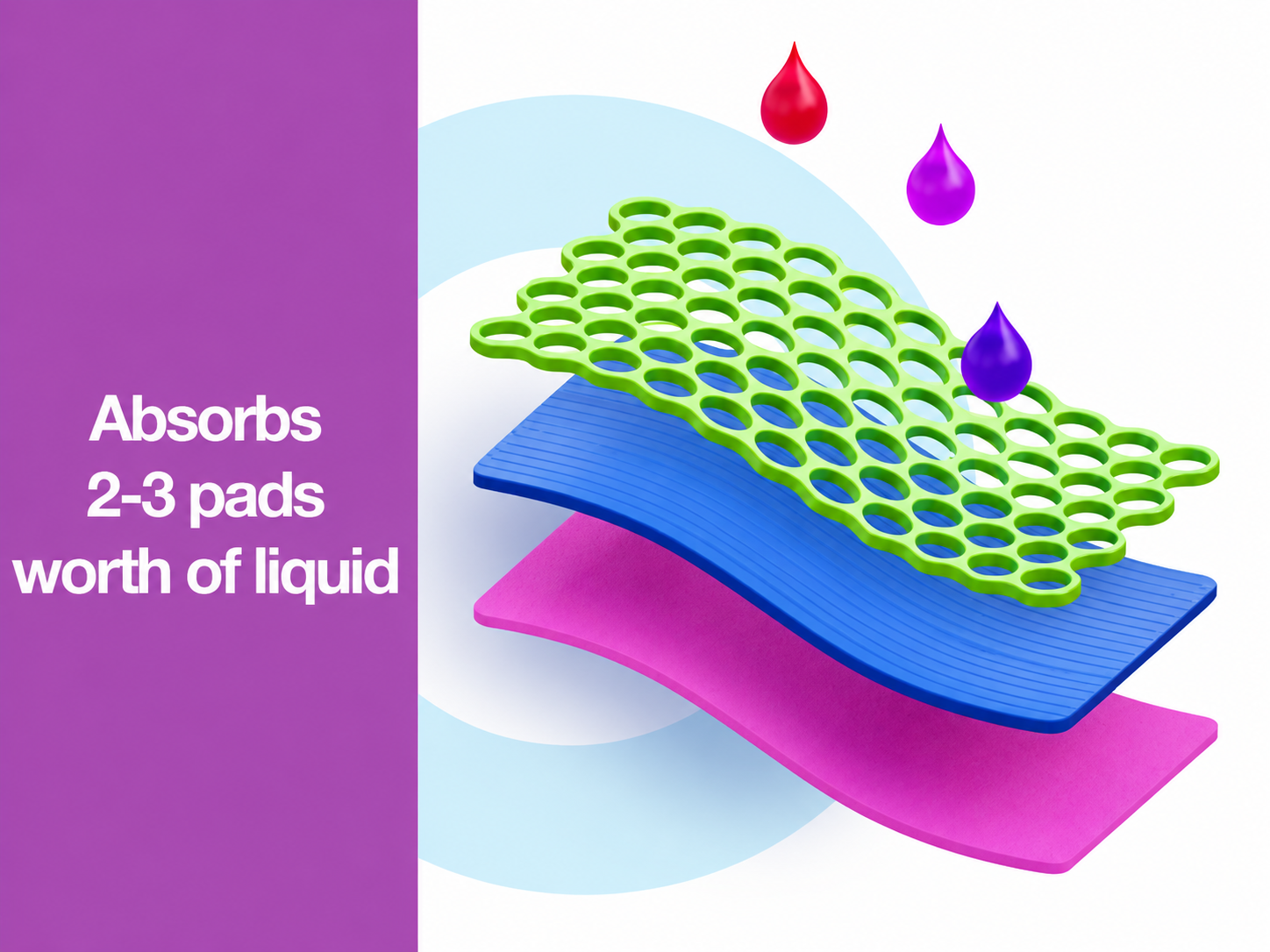
One pair absorbs roughly what two to three light bladder pads hold — without the bulk.
Odour: why pads smell by mid-afternoon
Urine is close to odourless when it leaves a healthy bladder. The smell develops when bacteria break down urea, and that reaction needs warmth, time and air — all three of which a worn pad supplies, because the liquid sits in an open top layer against the skin.
An absorbent core pulls the liquid down and away from the surface and holds it inside a treated matrix, so the reaction never really gets going. A cold rinse when you take the pair off resets it completely, which is why long-term customers rarely mention odour at all.
Environmental footprint over five years
Three pads a day is about 1,100 to 1,400 items a year, none of which can be recycled because they combine plastic film, adhesive and absorbent polymer. Over five years that is roughly 7,000 items from one person.
The washable alternative over the same period is around twelve garments plus the water and electricity of a cold cycle added to laundry you were already running. There is a footprint either way — it is simply an order of magnitude smaller.
How to switch over without a stressful first week
Nobody should test new protection on the day of a wedding. Build confidence in three steps instead.
Day one: wear a pair at home. You are learning how it feels, not testing capacity.
Week one: wear it for a normal day out, keeping your remaining pads in the bag as a safety net you almost certainly will not open.
Week two: wear it to the thing you have been avoiding — the class, the long drive, the day with the grandchildren.
Keep a small pack of disposables for travel days with no laundry access. Using both is not failure, it is planning.
Try DryGuard for 90 days. If pads were better, we refund you.
After my hysterectomy I leaked every time I coughed. Pads shifted and smelled. My first DryGuard pair held through a two-hour walk and I honestly cried a little. I've worn nothing else for four months.
Margaret T., 62Columbus, OH · Verified buyer
Nobody can tell — that was the whole point
They look and feel like regular briefs under leggings. No crinkle, no bulk, no smell. My daughter borrowed a pair postpartum and immediately ordered her own.
Denise R., 58Sarasota, FL · Verified buyer
Saved me about £40 a month on pads
I washed the first set over 60 times and they still hold. It paid for itself in the second month. Ordered the 10 pair so I never have to think about laundry day again.
Yvonne K., 67Leeds, UK · Verified buyer
FAQ
Comparison questions
Dry for 90 days or your money back
Wear them. Wash them. Put them through a real week. If DryGuard is not the most comfortable, most reliable protection you have ever worn, email us and we refund every cent — worn pairs included, no return shipping needed.
Full refund of what you paid, including shipping
One email to support — no forms, no phone queue
Keep the pairs you already wore and washed
Refunds land back on your card within 5 business days